
Boys in the Basement
J. Cornell
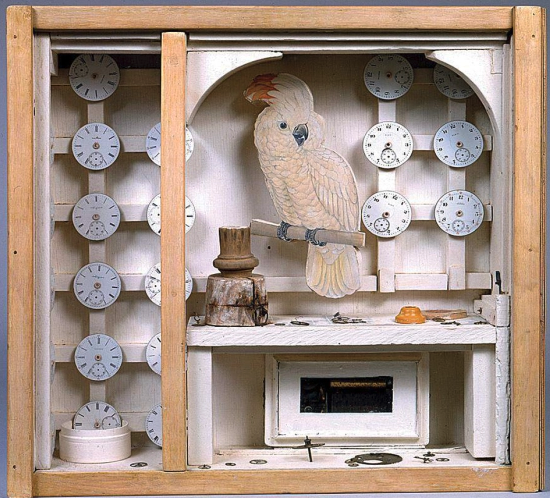
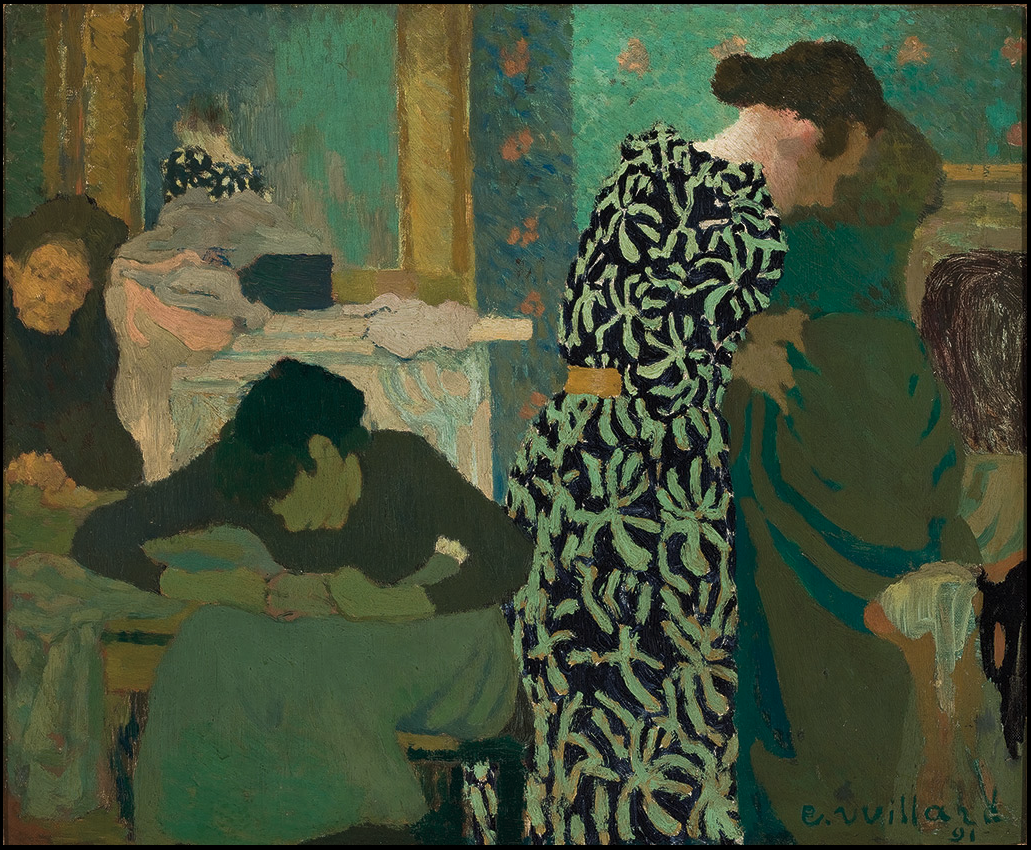
Just the other day, I sent a picture, almost at random, but who really knows (I’m given to synchronistic fatalism), to my friend Daniel. I ran across a story about a new Joseph Cornell show at the Gagosian in Paris. I’m a big fan of the assembler, so I found a picture of one of his constructions to add in response to something Daniel had sent me earlier. He didn’t know about Joseph and his little boxes, but the picture sent him reeling. In not too many minutes time, he sent me a text saying Joseph Cornell was his new favorite artist. Ha! Who am I to disagree? We got into a discussion about the artist and how he lived and work (he lived with his mom and brother and learned to make his own boxes). I told Daniel that I recently learned that Vuillard too had lived with his mother. Daniel got to work. He sent me a list of male artists that lived with their mothers. Here are a few: Whistler (of course…), Andy, Warhol, Toulouse Lautrec, and Georges Seurat.
In the final paragraph of her article about young men’s 21st century passage into adulthood for The New Yorker, What Did Men Do to Deserve This, the author, Jessica Winter, summates that it (men/boys quagmiric identity ontology) was ever thus. Essentially the piece is an analysis of different male authorities’ diagnosis of the male ego in extremis. And, while a lot of what she says is pretty trenchant, I can’t say that I didn’t feel her tone to be a bit caustic - maybe that’s fair - but, to be perfectly frank, what the hell does she know about it? With an imploring retort like, “…explain how a women’s attainment of economic independence would cause their husbands to be stripped of anything,” well, it just proves, definitively, her obliviousness of the goings on in the male head. To quote Marshall Mcluhan in line at the movies in Annie Hall in response to the “pontification” by the Columbia professor, “You know nothing of my work.” One might even, if one had a mind to, suggest that the greatest male thinkers in history have asked the corollary question, famously fomented by Freud, that is universally and satisfactorily acknowledged to remain elusive: “What does a woman want?”
Get in line Jessica.
So then, to paraphrase, “What does a man/boy want, and what are ya gonna do about it,” seems to be the central problem awaiting the unpacking in this story. To my mind, most of this article sounds like three blind mice trying to pin the tail on the donkey wearing post - post modern reference eye patches. But let’s have a peek.
Here are the component parts of the article without the excruciating attributions, because, after all, what’s the point - how fine, and many times can this particular hair be split?
Young men are becoming red-pilled groypers of the manosphere. Whatever that means, it’s not good.
Boys need to be developed with values that will serve them well as adults (hence they will become anti-groyped/ungroyped/groypless).
Young men need real opportunity to thrive, but are hopelessly mired in the hopelessness of a rigged financial system (although none of these esteemed contributors hold a very sharp pencil on that front).
Finally (oy!), the author weighs in with her nanny-nanny-boo- boo reflection that is something akin to, “I’m rubber your glue, whatever you think your problem is its mine too.”
All of these parts have some salience, I guess (although, I may be being too generous), but none, I think are even approximating the the approximation with any true discernment, and that’s probably because they, like everyone else has given up. And who can blame them? These analysts are living in their digital boxes with big mortgages and propaganda to sell. And they better sell a lot and often. We’re all in that. Lucky be the man (and woman too…) not trapped inside that particular cage.
I’ve always been a big fan of the publisher of this article, The New Yorker. I’ve been reading it since I was a scratching my head trying to understand why the comics were funny. And now, I am scratching my head again trying to understand why the comics are funny. It’s almost a daily occurrence when I see a New Yorker cartoon and say to my wife, “these damn comics ain’t funny no more ( I live in Missouri now, so you know, when in Rome…). But since Bob Mankoff left, meh, I don’t much read the funnies, or enjoy the covers. All that aside, I still love most of the stories, and if an article as meaty as What Did Men Do To Deserve This, comes out, it pricks my ears, but unfortunately this one rankles my craw.
I was a small kid growing up, I remember, I weighed 67 lbs, in the sixth grade, and not much more for many years. And get this, I was artistic (dear god). For any boy, the vulnerabilities abound, and there are always bigger better boys to remind you just how small (in whatever way) you are. It’s rough for boys, no doubt. It’s rough for girls too, but I’m not an authority on that (which makes me wonder why a woman would write this article?). Every boy has his particular coping mechanism, most never outgrow them, I don’t think. I’m nearly 70 now and all of my childhood friends remain, I’d say about the same they were when we were 14 years old. Boyhood is a bonebreaking experience and then it gets worse because girls get involved, and then the real trouble begins.
When I first read this article I was immediately transported to The Dawn of Everything, a book that I read several years ago by the late anthropologist, David Graeber. It made sense to me. He upended conventional and long accepted theories of hunter gatherer tribes. Essentially he argues that life in early societies was fluid with no set boundaries, roles or expectations. Societies were non-hierarchical, but that narrative all changed when Rousseau developed his myth of a rigid, gender defined property owning society which helped the exploitative Europeans justify their colonialism. And then, just like that, just like in boyhood adolescents, the trouble began…
You see, to my mind, the whole kerfuffle of this, “boys won’t/will be boys,” discourse is built on the flimsiest of filaments. So it’s decidedly pretty lame. All of this nonsense arises from these defensive and recent Rousseau (he died in 1778) justifications. And with time and speed, and now hyper cosmic momentum, the myth has disintegrated into tachyonic atomic disruption. What’s a boy to do?
Was a time when you could go a courtin’; was a time you could leave the little lady at home; was a time you could be a damn good provider. You could be (had to be) that mythic character out on the range, a foot propped up along a wooden rail, leaning into a sunset of pinks and golds out along a distant horizon; just you, man against nature, and by god you tamed it: A Marlboro man smoking, rough skinned, and independent. Tough, rugged, capable - a man’s man - punchin’ cattle by day, stew-eatin, pappy-readin’ to the kids by night. Well, we all know how that Marlboro man’s life really turned out; seems he was peddling a cancerous myth and it pushed him - rough and ready - right off the covers of LIFE magazine into a respirator and then right into a box six feet under.
You see that myth, that fiction, was just another way to sell commodities. Truth be told it wasn’t at all benign, it was metastatic. And in his book, Bowling Alone: The Collapse and Revival of American Community, the author Robert Putnam outlines with his singular bowler analogy, how truly murderous the legend is to the social capital. Together with increased economic inequality, and political polarization, Putnam concludes the conditions are ripe for isolation and anomie. Oddly, the book was published in 2000 and Putnam thought at the time that social media would ameliorate these conditions. So much for that…
I was struck by this poll that came out recently: According to a 2023 Pew survey 58% of Americans believe life is worse today than fifty years ago for people like them. It seems illogical, but is it? Since 1975 life in America has increasingly been outsourced, and I don’t mean just jobs. I think the abdication of government to set and maintain the principles of the constitution have effectively outsourced the values of American culture to the market, but Adam Smith’s Invisible Hand was never intended to hold, manipulate and define the values that blueprint the construction of our behavior. And yet it has. And the thing about that is, it runs contrary to our understanding of what values should be. Profit. Margin. Percentage. Cash Flow. Liabilities. ROI. Assets. Balance Sheets. Feeble descriptors of the richness of life, and yet our society has allowed an entire culture to embrace these words as fundamental - hell, they’re existential. American culture has been stripped bare to the bones of nuance and beauty. And as Yuval Harari describes, empathy creativity and ethical reasoning are our only way to reclaim our humanity and not surrender to “outsourcing meaning” to a pernicious commerce state. Failing this, his warning of consequences are not good. Not good at all.
Today we have been blasted into nuclear time with a lizard brain. The sustaining Marlboro myth of American masculinity has been exposed for the corporeal tumor of fiction that it always was. Cultural adhesion has been melted by and for a pot of gold. The abiding humanism that enables and justifies communal cooperation has been hollowed out for what? For Nvidia, and Microsoft, and Apple to increase their $4 Trillion dollar market capitalization? To reduce the arbitrary, mystical, unfathomable, curious, mystery of life into data driven pustules of digits that resemble some hieroglyphic inevitability?
The world is accelerating - spinning at an inconceivable speed. Robots. Gizmos. Passwords. AI. Technology. Podcast Fakery. Fuckery. Dickery. Scams. Technocracy. Capitalism. Me Too. You Too. Everybody Too. And in this world there are only a few winners. And these winners win big. Houses, cars, boats yachts and girls, girls, girls. What’s a boy to do when the myth of who he is and should become has been dynamited into a fractured and discontinuous mosaic? Where his understanding of a tree, or a flower, or a bear is nothing but a contrived fiction of digits that lock his wiggly sweaty cortex to some sleek and rigid device designed to suck the history of millennia out and zombify the unsuspected with a digital lobotomy? Where’s the glue, the grid, the instructions to stave off the calamity? I’ll tell you where. Buried somewhere in a distant Madagascarian landscape and in our little subcortical walnut limbic amygdala. And it don’t play.
In their basements, water pouring in, adrift in a sea of incompatibility, our little sailor boys look for a distant horizon to row their little ships to safety. But it’s all a mirage. Just more fiction. Fast fiction. One boy finds a bottle of red pills and points, “It’s there, it’s there!” Another finds a little statue, and points. “It’s there, it’s there!” Another finds a cross, another a swastika, another, a boy scout badge. Their chorus barely escapes the basement. And they continue adrift, eyes on their digital compass that points only in one direction. And so they are castaways in the basement; losing the light in their eyes, their thumbs an unexpected hypertrophy that challenge even Sissy Hankshaw’s pollexes, and the water is rising. Stranded in the basement at forty, in this context, seems to be a pretty likely, if not optimal, outcome to these conditions of disorientation and displacement, and just downright confusion.
For us, artist like me, sensitive boys like the artists that lived with their mothers, know this basement confinement. Have always known this basement confinement, but it was never thus. The basement for Warhol and Seurat, and Lautrec and Cornell, was a sea oasis - full fathoms of creativity. When Daniel and I exchanged our texts about these artists that live with their mothers, we didn’t talk about what that meant for the artists, we didn’t have to. It’s there, that’s all there is to it. Within the walls of their homes, the water did not rise, community did not break down, the world was not fractured. They were not adrift. The fiction - if it was a fiction - was the community of place. Of safety. Exploring dot paintings, or drawing in gold, or placing found items in boxes, the conditions that brought us these miracles were not digital. It was not independent. It was to my mind more akin to the free flowing cultural identities of community that allowed/encouraged shifting roles, and fluidity of hierarchy. Communities that were adaptable, and flexible. Transmutable. Life and all its horrible beautiful complexity was never ever meant to be reduced to a couple of digits, it was meant to be the delirious colors and metaphysical shapes that our heroes in the basement produced. To do otherwise… well, that’s not good. Not good at all.
Vuillard