
A Sacredness
Michael Heizer’s Landscape
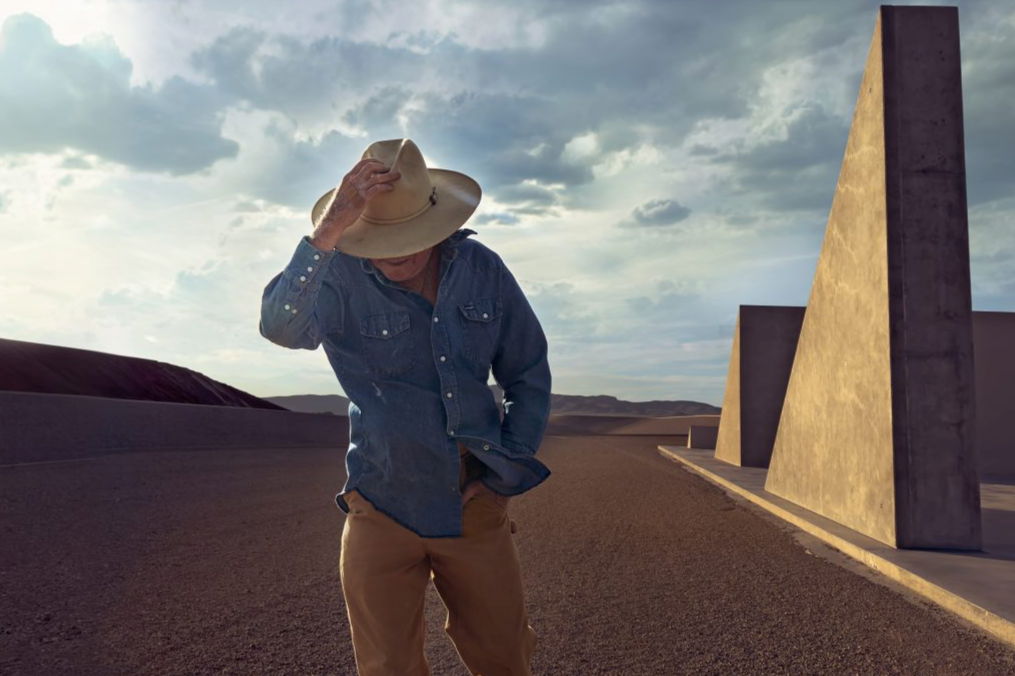
I’m a quiet man. I just make art.
Puzzles. My mom, my friends, like to do puzzles—whatever—crosswords, Sudoku, word jumbles; keeps the mind active. I have never liked to do puzzles as such. But I make art. And in effect, isn’t all art-making a kind of puzzling? The difference is there is no template, no blueprint, nothing specific to fill in, no order to establish, no objective outcome. In art puzzling, you have parts and pieces: In music—sounds, and silence: In painting—marks and space: In writing—alphabets and punctuation. But that’s it, the puzzle you make as an art puzzler is one you invent, you make the puzzle pieces, and you make them fit according to your own imagination.
Just last year, at the MFA Boston, I saw a little Stuart Davis painting. If I hadn’t seen it in person, I would have not known of it, but what struck me was how within this picture, a small object was only very loosely defined by a texture and a contour line that was not-so-closely lassoed into place. It unstuck the picture and gave it breathing room.
This 20th-century invention of formal deconstruction is the singular greatest achievement in picture-making. It found, in painting, its fullest expression in Pollock’s splatter paintings. Not only were they non-referential, they were nonlinear. It was the great exhaling. After that, painting became post-something (fill in the blank), but still found, and continues to find, ways to be exhilarating.
I’ve been thinking about Michael Heizer, the land artist, for a few weeks now, ever since I saw a picture of a rounded and elongated stone, Negative Megalith #5, 1998, tightly encased in a wall at Dia Beacon. It struck me with a vague discomfiture that I set out to try and understand. Somehow in me, this big rock, in this setting, tapped against a deep subconscious vein of meaning. And I’ve felt it time and again looking at his artworks, and I want to understand why. As Dana Goodyear said in her 2016 New Yorker profile of Heizer, “What hand made this, and what for?”
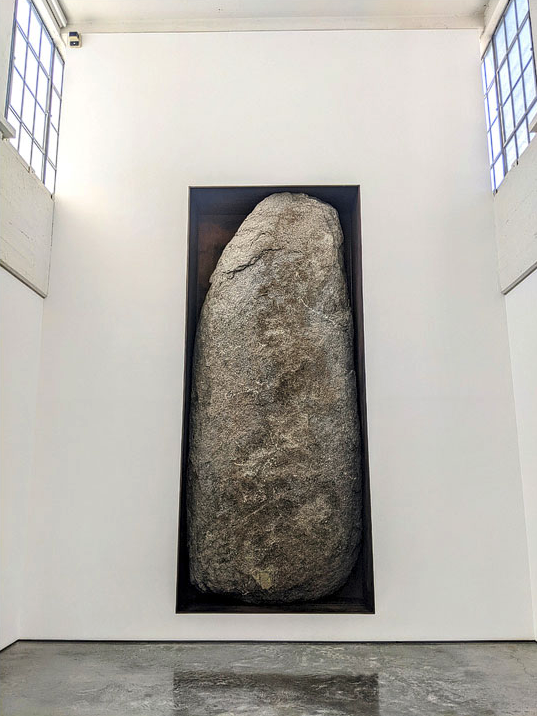
Michael Heizer, Negative Megalith #5, 1998
Heizer started out in the early sixties as a painter, but having gone on digs as a child with a father who was an anthropological archaeologist, his intentions were more satisfied when he went west with the artist Walter De Maria. His palette more satisfied with the scale, like the Olmec culture he saw with his dad. Raw materials became the landscape—sky and land, earth and light.
The vistas of a wide open desert space, rather than New York galleries, must have felt more familiar to Heizer as well, and creating the inventions out there, a predestination. But these vistas—these vast spiritual horizons—must have awakened—or re-awakened—in him his reverence for the elements, “reserving the rock’s own nature—that’s the spirit of the rock. Let the stone be its wild thing,” and the work he created radiates a profound empathy and gratitude for its history. Michael Heizer and the art he imagined with these “valueless” materials have become mythical: a western cowboy-god, Ash, astride an infinite canvas of desert at his Sleep Late Ranch.
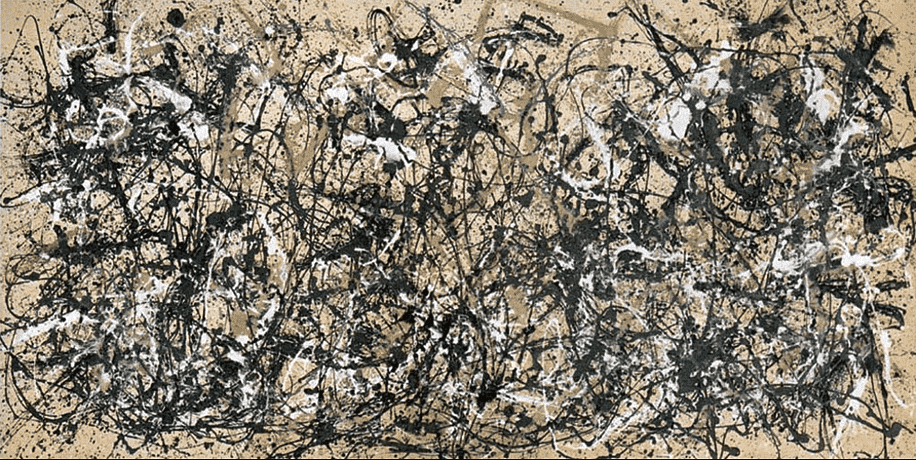
Jackson Pollock, Autumn Rhythm (Number 30), 1950
The lineage of artists from Duchamp to Picasso to Pollock gave Heizer license to do what he did. When Heizer headed west, the art train had long ago left behind at the station, the artist alone in his studio with paint and brush caricature. The innovations that preceded his retreat, like the deconstruction I mentioned earlier— deregulated materials, broken space, subjective edges— in their entirety, released Heizer to make poetry in collages of valueless materials and activities, and in the process of his veneration of them, elevated them to a kind of sanctity. And he made them with astonishing gusto, tenacity, and certainty: “As long as you’re going to make a sculpture, why not make one that competes with a 747, or the Empire State Building, or the Golden Gate Bridge?”
The road of deconstruction that led to the Heizer landscape has been the direction of art since Cézanne—when apples became something more than and something less than apples; when Picasso faceted space; when Pollock’s gestures and materiality obscured intention and activated the power of chance. On the road, the window of representation changed from external depiction to the embrace of the external itself. The peril of the road seems to be the extinction of the value of the artist’s ability to accurately represent the world through a window facing out. If that’s gone, then what is artists value? Isn’t it axiomatic that as things become less virtuosic, they become more common? Of course, we (artists) must be mythic, legendary, stand apart, as mediators of transcendence. But modern art has been a tightrope act hovering between the genius (yes, tongue firmly in cheek) and the everyman with an increasingly sfumato wire. When the wire is so obscured, how do we maintain the balance? Should we? Is there a wire? These are the dialectics that Heizer exploits to sanctify the intolerable commonness. Somewhere out there in the Nevada desert, the space between (as Rauschenberg says) will be consecrated.
With a jigsaw puzzle, the goal is to complete a picture by placing adjacent and complimentary shapes into one another until the whole thing locks together. In the process, the puzzler goes in and out of negative space. Positive and negative space. Herein lies Heizer, the promethean puzzler’s pivotal process, and all of his work can be enjoyed and understood within this simple idea. Of course, Picasso did it with his guitar sculptures as far back as 1912, and for Heizer, it’s really the same thing: voids and fills: positive and negative space, but with all kinds of post-American 21st-century accoutrements and associations. And with an immense impact. I’m not sure you could say that Picasso’s sculptures at the turn of the last century were sacred. Henry Moore gets closer, but sanctification is the rub on which Michael Heizer’s inventions rest— making the common sublime. Introducing into the, or rather, re-introducing the, blessed, the ceremonial, the pure, and venerated into high art.
Heizer’s high art was paradoxically built by the commoners.“These are young guys that I can rely on. And I need them, and they need me.” He donned the clothes of the everyman, working with builders and blueprints: politicians, lawyers, grant writers, girlfriends, leases, permits, and scale maps. Driving tractors and backhoes, nearly working himself to death, “My rib cage is blown out, my feet don’t work. Every bone in me is torqued and twisted.” This post-post-modern collaboration of art for art’s sake is exceedingly modern (or is it? Northern Renaissance guilds come to mind).
At its core, Heizer’s works could not be simpler. Dig a hole. Fill a slope with the dirt. Choose a rock, move a rock. Any landscaper will have done these activities a million times, and yet with these simple materials and activities, Heizer managed to become a legend. How were these common activities with common materials infused with transcendence? How did they become so enigmatic as to reside in a sacred space? A limbo, where Heizer as archangel, a bodhisattva, created forms that at once exist and don’t exist - 350 tons of ephemera. Work that has immense value and absolutely none at all. Enormous but hidden scale. How are they at once profound and deeply suspicious? That’s the mystery door to the sacred, to be one and both at the same time.
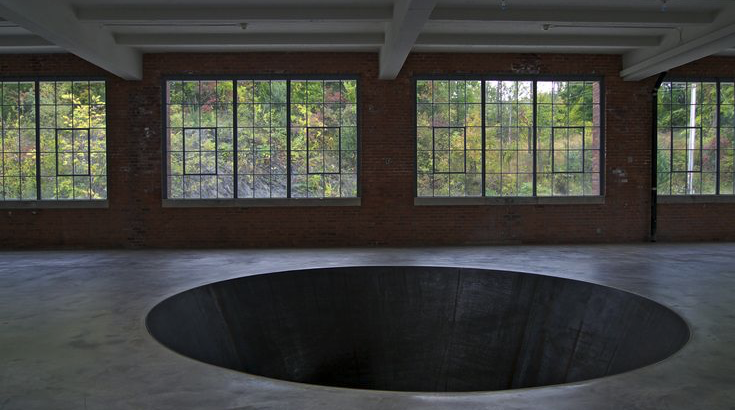
Michael Heizer, North, East, South, West (1967/2002)
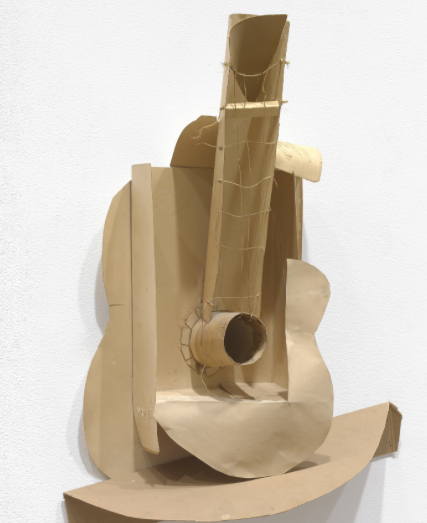
Pablo Picasso, Cardboard Guitar, 1912
Making the holes, the negative space of Heizer’s work was not simply a formal device as were Picasso’s. These voids carried the weight of the ghosts of which Picasso knew nothing in 1912: the vulnerability of the landscape to casual rupture by war and nuclear weapons (is it a coincidence that the work resides out where military installations and war practice is hidden but constant)? They are just holes and gullies, but they also carry the weight of the rat tunnels of Vietnam and the trenches of the First World War. In fact, because Heizer identified the sacredness of subtraction in his work, holes today hold history beyond their formal association with cubism. They are the 21st-century repositories of a hollowed-out past, monuments to unspeakable folly in Vietnam and memorialized loss in the Twin Towers’ depressions.
Heizer’s formal practice of displacement has created holes all over the world. Famous holes in Germany, Switzerland, and in museums like Dia Beacon. He has made holes that collapse into canyons, holes that have beams collapsed into them. He has made panoramas of photographs from the bottom of holes he has dug. He has made long lyrical and long jagged holes that are reinforced with steel liners. He has bulldozed holes into shapes to conform to a formal contour. He has made holes that look from a satellite like lines from the Nazca civilization 2000 years ago.
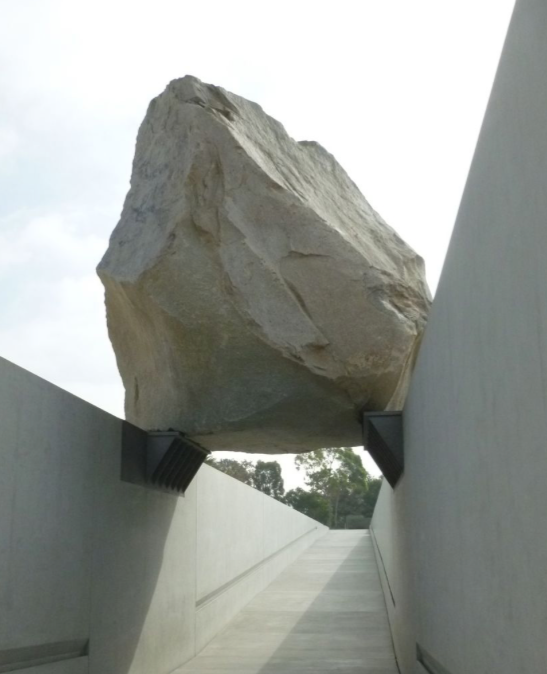
Michael Heizer, Levitated Mass, 2012
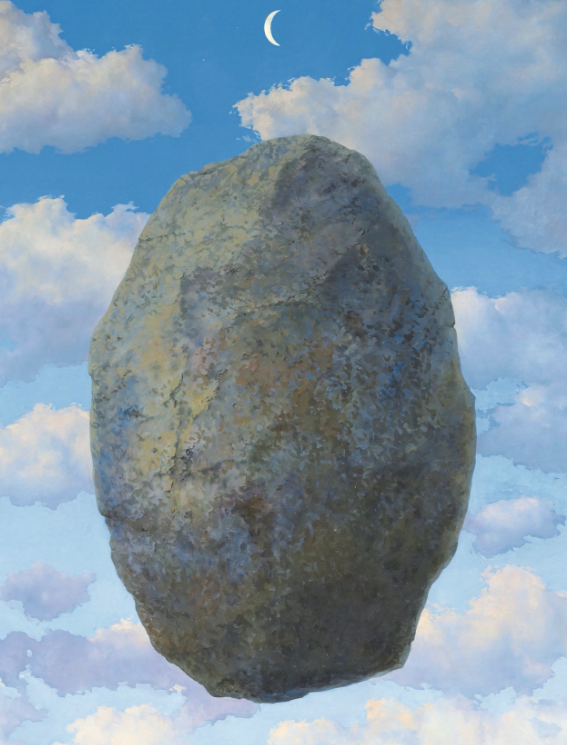
Renee Magritte, The Glass Key, 1959
He has built mounds and moved rocks to improbable spaces. His Levitating Mass, reminiscent of Magritte’s painting The Glass Key, 1959, from the Menil Collection - also home to several works by Heizer - is a 350-ton rock that Heizer found, selected, and had trucked on a specially made extendable trailer through handpicked streets at night to rest aloft above a walkway as a permanent installation at LACMA. The engineering to disguise its threat as you walk beneath it gives way (so I’ve heard) to a kind of dreamy otherworldliness (you can imagine it if you have ever walked within one of Richard Serra’s leaning steel ellipses). He has made mile-long mounds at City and enormous animal mounds at Effigy Tumuli. The reclaimed Indian burial grounds.
Joseph Campbell, the great mythologist, describes the solemnity that occasions walking into the Cathedral at Notre Dame through a facade guarded by gargoyles; the intention is, he said, to transition from daylight to another realm, to the sacred. It is a gateway, a promise, a belief that upon the exchange, we are transported to another but equally accessible experience if we decide to take it. Heizer utilizes this kind of transition himself, if only because the work he created, as in City, can be so remote that access to the experience is conditioned by the enormity of the pilgrimage. And the access to the pilgrimage is, in fact, quite limited. “I never even considered people anyway. You make art for people to look at, of course, so maybe you presume people are going to go there one day. But not a lot of them – it ain’t gonna happen.”
“Art is about seeing, not recognizing,” Heizer said, and I think this gets to the puzzle of the “rock in a box” as he describes the million-plus-dollar sculpture that I found so enigmatic. As I’ve come to understand Heizer—the arc of his career and the interests and accomplishments and the character of the man—this statement seems, of all, the most salient. Because for me, it is not unlike Rauschenberg saying he lives in the space between art and life. This Heizer work is like that—again—the same lesson over and over. It’s not about the rock or the container of the rock, it’s about what the space between and behind the rock and what the enclosure does not define. What are the whisperings of this inscrutable place? You see, I don’t think that Heizer is interested in the concept of dialog; in fact, it feels downright antithetical to his persona. No, what he’s after, I believe, is the simplicity of juxtaposition—in its incongruity or its harmony, and in this, he is a surrealist. It is the spaces between recognition that spark something deeper than language, deeper than thought. It’s the simplicity of the particularity of the thing—layered, of course, with the full knowledge of art history formalism. The oneness, and that is what ultimately makes it sacred.
The underlying mechanism of Heizer’s work is a paradox created by his use of oppositional forces—similar to jigsaw puzzle pieces that, if they were magnetic, would repel one another—but because they are both cardboard, they fit one into the other, clicking together and eventually revealing the whole. Heizer’s intentional use of opposing materials further complicates, or should I say enriches, the puzzle. Deconstruction and reconstruction; mass and lift; an uninhabited city; monumental sculpture covered in fields of grass; an intimate experience of immensity; the elaboration of minimalism. In true reserved form, we can say that these are the paradoxes that create the legend of Michael Heizer. And it’s true, I think, he lives it. I would not say even believes it, but he is, as his works are, simply so, singular and distinct. It’s not that he would deny the formalism of his projects; I just don’t think he’d either admit it or he’d say something dismissive, as in, “What I’ve got going on in the hole is a whole other critter. It’s pure.” It’s just that in the trajectory of life as a hero, he has straddled competing forces of commerce to live out his ambition. By obsessive doggedness and in an inverse and recursive way, he expanded the vocabulary of modern art to include or re-include what Edmund Burke called the “delightful horror”—the ancient and overwhelming sublime. In the process, Heizer has answered the ephemeral, “what for”—he’s made it sacred.
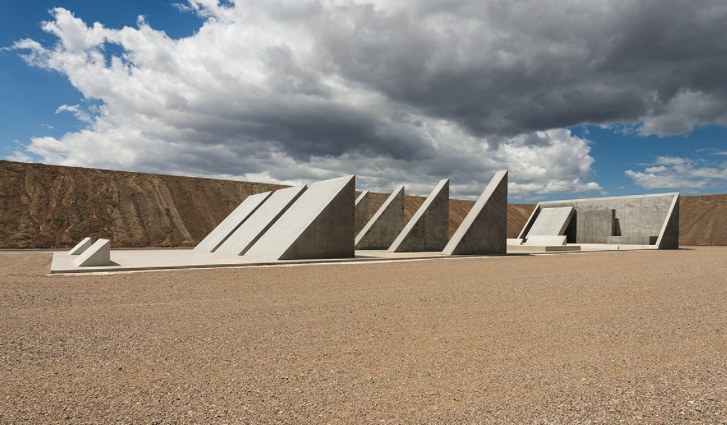
Michael Heizer, City 1997 - 2022