
The Hungry Fighter
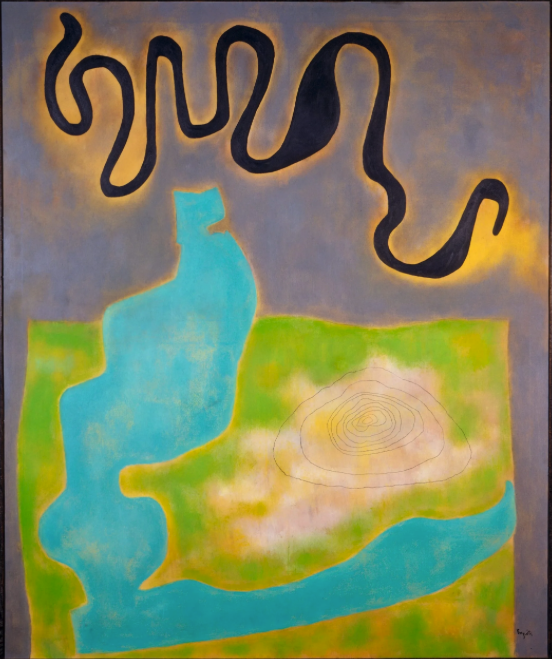
Congo, 1954
William Baziotes
You wage your own battle all by yourself: Gene Tunney
For nearly fifty years a painting I barely remembered has stayed with me, flickering at the edge of memory.
I first saw it at LACMA in the early eighties. It was before the other Southern California landmark museums had been imagined - the Geffen (née the Temporary Contemporary), MOCA and the Getty - among others - and it sat right in the heart of LA, where my pal Daniel, lived. They put on big and rare exhibitions, and we went to all of them - or so it seems. One of them I remember most was a Motherwell retrospective around 1983. I saw it many times, and it changed my life, as did the museum generally. You see, I had never been able to see important original paintings before, and the museum had such a range of them that the permanent collection was, for me, transformative.
On the fifth floor of the old building, as I remember, there was a wide entry way into the hall I was most interested in - the modern stuff - and the first painting I saw was the great Tea picture by Matisse. It was big and green, sun dappled with a dog scratching in the shade. I was overwhelmed by its achievement, but it was just the start. Beyond that, further into the hall and adjacent rooms, I saw paintings by Picasso -Portrait of Sebastien Jener Vidal - Franz Kline, and the giant 7’ x 20’ canvas by Hockney - Mulholland Drive.
Among these monuments, I was struck by a modest-sized painting by a painter I knew nothing about. Tucked quietly on an adjacent wall was the 7’x 5’ picture (its dimensions much bigger than I remembered them to be), whose aspect has lingered behind my eyes for nearly half a century. Why, I’ve wondered, of all those paintings - when I couldn’t even remember the outlines of this one - did it have such vague persistence for me? Why did it haunt me? I have been living with the painter for a few weeks now, and this writing is my investigation into that mystery.
The painting at the top of this writing is the piece in question, Congo. Painted by William Baziotes just couple of years before I was born, it’s an abstraction with no discernible meaning or intent. No horizon - just some forms set against one another and painted exquisitely.
Baziotes was from Pennsylvania, an American, and he was considered, as I recently read by some critic, a second-tier artist among the Abstract Expressionists (a distinction I have come to understand as wholly meaningless and, in its ignorance, shameful). He lived in the first half of the 20th century and joined other artists embracing the ideas of European Surrealists after they emigrated to the United States to escape fascism in the 1930s. He joined first-tier artists like Motherwell, Gorky and Pollock in grabbing hold of the ideas of surrealist automatism and running with its sketchy outlines to create a school of art and a persistent practice that endures today. To showcase their ideas of automatism and internal subjectivity, the Kootz Gallery in 1949 celebrated them with the imprimatur, The Intrasubjectives (an incredible list of artists identified on the back of the catalog). What these artists created from these appropriated ideas became foundational as they constructed their unique signatures.
The Intrasubjectives Catalog, 1949,
Collaborative Painting: Baziotes, Kamrowski, Pollock, 1940-41
I am intrigued by this rare picture created just as the New York school began to bloom (funded in part by the WPA - a lot to say about that somewhere else…). In it you can see how Pollock used these enamel paint drippings to build his future practice. You can also see how these five or six forms and their expression led to Baziotes future work. This kind of community of artists, from Baziotes’s perspective, was essential and meaningful. It was a secret pact of communication between the painters. I came across a couple of letters from Motherwell to Baziotes from the early forties. Their easy familiarity revealed to me, that this group - that would become the authoritative movement of the century - relied on the good faith of its artists to thrive.
All of these artists, including Baziotes, came out of the Cubist tradition, but were striving to incorporate into it the surrealist ideology. It’s funny to think of it now - when even chance is conventional - but at the time, the idea of approaching a blank canvas spontaneously by summoning the subconscious - was novel and a real head-scratcher. But it was these processes, that bloomed the stylistic range of iconography and application that heralded the supremacy of American art of the 20th century. And as each of the artists from the NewYork School differentiated themselves from one another, the “unconscious collaboration” remained. Their pictures, despite their individuation, stuck resolutely to their adherence to their foundational principles: flat plane, spontaneity, and abstraction.
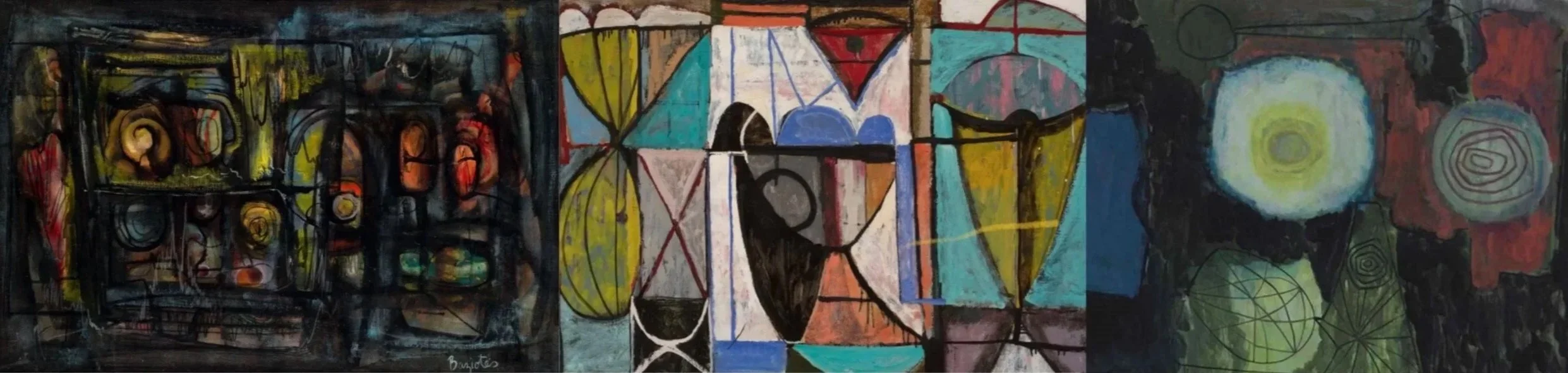
Mirror at Midnight, 1942 The Parachutists, 1944 The Parachutists, 1944
Baziotes’s escape from the grid - or, to put a finer point to it, his accommodation of the Cubist substructure - begins in the early forties. At that point in time his work had been either compartmentalized within a rectilinear framework or of peaking apparitions from inside. Then sometime around the mid -forties, the more mature Baziotes pictures began to appear. They begin to present free-floating figures, sort of untethered from the underlying construction, but firmly established on the picture plane. The figures and their associations take on an inscrutable psychological dimension, and this incipient dreamscape becomes - for the rest of his life - the methodology he will continue to explore and refine in his paintings.
While these pictures are illustrative of some formal leaps, there is little indication of the beauty of the mature canvases Baziotes will make as his career develops and then ended by his death from cancer at just 50 years old in 1963. It’s jarring to think of a mature style for someone who died so young; had he lived, this style would most certainly not have been his mature style. Still, we can look at this last approach and see that it is distinguished by what I think are three defining traits: they are pictures with a subject, populated with biomorphic forms rendered through a meticulously layered and deliberate application of paint.
Most of the New York School artists went on to paint Pictures of Nothing, as Kirk Varnedoe would write, but there are a few painters from the group that made pictures of something or, more precisely, vaguely suggestive of something - Adolph Gottlieb for one, Arshile Gorky and de Kooning among a few others. Baziotes’s pictures through the 1950s and early 60s become more and more like dreamscapes: little scenes of something captured at a glance. In them, biomorphic apparitions float together in vague horizonless atmospheres. They are woven together within a shimmering surface threaded as tightly as a Cezanne landscape. The formal qualities of these paintings coalesce, creating an exhilarating poetic resolution to their internal contradictions. Baziotes said he worked on many canvases at once, without preconception, and it would take up to a year for him to complete a canvas. By reconciling spontaneity with deliberation and ambience with structure through slow automatism, these intricate surfaces seem to evoke, inevitably, a reverie of lost memory.
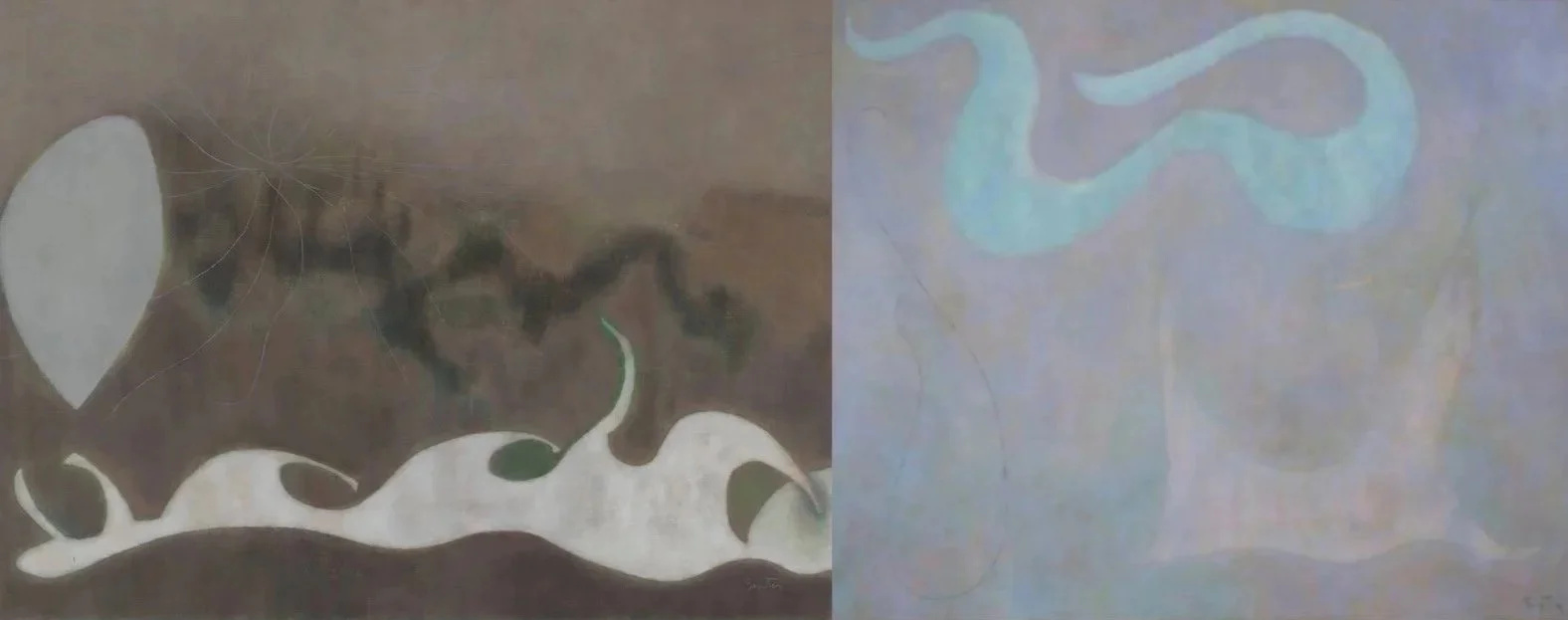
Serpentine, 1961 Opalescent, 1962
One of the great American art writers, Peter Plagens, wrote in Artforum in 1978, that, had there been such an award, William Baziotes would have won the “golden brush for best employment of line in painterly paintings.” In the forties, a few others in his circle might have been contenders - Matta, Gorky, and Motherwell. For these artists the direct expression of line is a link to their roots in surrealist automatism, and each used it differently, but for Baziotes his line, like his other iconography, is interwoven into the surface as an evocative filament: distinct but inseparable.
Baziotes’s deceptively simple surfaces are an exquisite, sensual seduction. He said he wanted to paint a surface with the beauty of a woman’s skin, and his methodical process of layering, glazing and scumbling produced the opalescent shimmer that webs together the imagery. What distinguishes Baziotes surface from the “all-over”patterning of, say, Pollock are the lyrical shapes embedded within it. The shapes, or “phantoms,” were never planned, but instead grew intuitively into the biomorphic outcomes favored by the process of letting go. His forms, reminiscent of Jean Arp and Gorky, are vaguely representative of life, but their juxtapositions within the surface articulate an inscrutable psychological narrative that seems to be a kind of primeval water-story. Baziotes’s still animations reflect the early Intrasubjectives' vision - psychophysical shapes standing in for the vitality that underpins organic life.
The subheading of this writing, The Hungry Fighter gets to the core of the beautiful painting - Congo - albeit wonderfully obliquely. Surprisingly, Baziotes shared another affinity with Surrealism besides its formal concepts: the appeal of boxing. The Surrealists used the sport as a proxy for their ideology, but Baziotes was more direct. He wanted to be a boxer and was serious about it in Reading before moving to New York City, in the early 40s. It’s curious to think of these fluid late paintings coming from the ham-hand of a pugilist, yet, it may help explain the mysterious resonance of these pictures. Maybe the “reveal” in his paintings was the unconscious resolution of his attraction to the monstrous and his more profound poetic nature. He said, “I believe this feeling of grotesqueness comes out in the figure,” referring to The Dwarf, - a recurring subject in his paintings in the mid-to-late forties. Buried within the subcutaneous layer of the surface is the fight between these two underlying impulses. In Motherwell’s note of 1944, he alludes to some kind of schism with the “young Surrealists,” telling Baziotes that, “I love your instinctiveness + your emotionalism, but at the same time you need someone to make a map for you occasionally and steadily.” To me this suggests that in these early years, the contradiction played out in more overt ways that through time and experience, Baziotes would remediate in painterly expression.
The hard won images born of an early identification with the brutality of boxing found their way into poetic yet subtly ominous images like Congo. The canvas of the boxing ring became the canvas of the infinite as Baziotes fought his battle alone every time he approached the arena. And it is this image more than any other, that I take away from my time with William Baziotes: the artist in community with like minds yet wholly alone, left to find his own way, without a map or a template, but brave and determined and confident that whatever he found at the end of the rounds would be meaningful. He armed himself with the tools of a poet and a painter with the intention to “make beautiful forms fit together like a puzzle.” He held up the mirror to himself as he bore witness in the mystery of making pictures.